

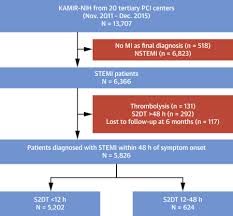
Article:, Acute ST-segment elevation myocardial infarction (STEMI) remains one of the most urgent cardiovascular emergencies. Prompt restoration of coronary blood flow is critical. The question of how outcomes differ between patients who receive timely thrombolysis and those who present late and miss the thrombolysis window is of practical importance—especially in settings where advanced intervention (like primary PCI) may not always be immediately available.
Background
Reperfusion therapy in STEMI aims to salvage myocardium, preserve left ventricular function, and reduce mortality. Thrombolytic therapy acts by lysing occlusive thrombi within the culprit coronary artery and has been shown to reduce infarct size and improve survival. Pakistan Armed Forces Medical Journal+3AHA Journals+3MSJ Online+3 However, its benefit is highly time‐dependent: the earlier the treatment after symptom onset, the greater the salvageable myocardium and the better clinical outcomes. Khyber Journal of Medical Sciences+1 In contrast, patients who present late (beyond the optimal window for reperfusion) may miss this benefit, and often are managed conservatively or with delayed reperfusion.
Objective
This article reviews and synthesises the available evidence on in-hospital outcomes for two groups of STEMI patients:
- Patients who received thrombolysis in a timely manner.
- Patients who presented late and did not receive thrombolysis (or in whom reperfusion was delayed beyond the beneficial window).
Findings from the Literature
Several studies illustrate the stark differences in outcomes:
- A study from Pakistan found that patients treated with thrombolysis had significantly worse outcomes compared with those treated by primary PCI, but importantly the thrombolysed group had a much higher in-hospital mortality (18.9%) compared with 3.8% in the PPCI group. Pakistan Armed Forces Medical Journal
- In another recent descriptive work, thrombolysis was effective when administered within the first six hours of onset (success defined by ≥50% ST-segment resolution) with a success rate of 69.1%. Khyber Journal of Medical Sciences
- More broadly, an analysis of a large national inpatient sample found that STEMI patients undergoing thrombolysis had an in‐hospital mortality of 12.34% versus 4.09% in those undergoing primary percutaneous coronary intervention (PCI). MSJ Online
- The principle that delay diminishes the benefit is clear: treatment beyond 12 hours of symptom onset confers little salvage and higher risk of complications. ResearchGate+1
From these data, even though thrombolysis is inferior to primary PCI, for centres and settings without immediate PCI availability, early thrombolysis remains a vital option—and its benefit erodes with every hour of delay.
Interpretation for Late-Presenting Non-Thrombolysed Patients
For patients presenting late (for example beyond 12 hours or with delays in diagnosis/transport), the window for safe and effective thrombolysis may have passed. These patients typically fall into the “non-thrombolysed” category within many registries. In-hospital outcomes in this group are often worse: higher mortality, increased risk of cardiogenic shock, arrhythmias, larger infarct size, and longer hospital stays. The literature implies the following factors:
- Lack of reperfusion or delayed reperfusion leads to more extensive myocardial necrosis, poorer left ventricular recovery, and thus worse early outcomes.
- Late presentation frequently correlates with systemic complications: shock, multiorgan dysfunction, higher risk of bleeding if late thrombolysis attempted, etc.
- Health-system delays (patient recognition of symptoms, transport, diagnosis, treatment initiation) contribute significantly to worse in-hospital outcomes. Khyber Journal of Medical Sciences+1
Practical Implications
For clinicians and healthcare systems, the key take-aways are:
- Time matters: Every minute counts in STEMI. Systems should aim to minimise time from symptom onset to reperfusion (whether thrombolysis or PCI).
- Thrombolysis remains important: Especially in regions or centres with limited access to PCI, early thrombolysis is still a recommended option rather than waiting. Delaying or foregoing reperfusion altogether carries worse outcomes.
- Late presenters need special attention: These patients should be managed aggressively with optimal medical therapy, monitored closely for complications, and assessed for possible delayed intervention if feasible.
- Public health dimension: Awareness of heart attack symptoms, rapid transport to appropriate centres, equipped emergency departments and streamlined protocols can improve in-hospital outcomes by enabling timely treatment.
- Triage and protocols: Hospitals should have protocols that quickly identify STEMI, decide on reperfusion strategy, and minimise door-to-needle times (for thrombolysis) or door-to-balloon times (for PCI). Indeed, a study found mean door-to-needle time of ~33.8 minutes and mean time from symptom onset ~6 hours for successful thrombolysis. Khyber Journal of Medical Sciences
Concluding Thoughts
In-hospital outcomes for STEMI patients are strongly influenced by whether timely reperfusion is achieved. Patients treated with timely thrombolysis fare significantly better than late-presenting non-thrombolysed ones. When reperfusion is delayed or absent, in-hospital mortality, complications, and lengths of stay are markedly increased. For centres without immediate PCI access, the emphasis must therefore be on rapid diagnosis, immediate thrombolysis where appropriate, and minimising all delays.
For readers of AlQuwahNatural.com, the message is clear: if you or someone near you experiences symptoms suggestive of a heart attack (chest pain, sweating, breathlessness, etc.), time is of the essence. Seeking immediate medical attention may mean the difference between a well-recovered hospital stay and one complicated by serious outcomes.


